sat suite question viewer
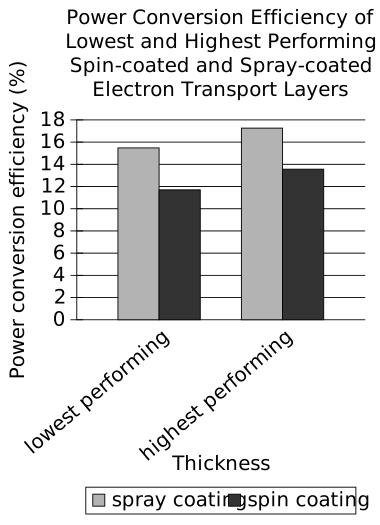
- For each data category, the following bars are shown:
- spray coating
- spin coating
- The data for the 2 categories are as follows:
- lowest performing:
- spray coating: 15.48%
- spin coating: 11.70%
- highest performing:
- spray coating: 17.26%
- spin coating: 13.56%
- lowest performing:
Perovskite solar cells convert light into electricity more efficiently than earlier kinds of solar cells, and manufacturing advances have recently made them commercially attractive. One limitation of the cells, however, has to do with their electron transport layer (ETL), through which absorbed electrons must pass. Often the ETL is applied through a process called spin coating, but such ETLs are fairly inefficient at converting input power to output power. André Taylor and colleagues tested a novel spray coating method for applying the ETL. The team produced ETLs of various thicknesses and concluded that spray coating holds promise for improving the power conversion efficiency of ETLs in perovskite solar cells.
Which choice best describes data from the graph that support Taylor and colleagues’ conclusion?
Explanation
Choice B is the best answer because it describes data from the graph that support Taylor and colleagues’ conclusion that spray coating holds promise for improving the power conversion efficiency of ETLs in perovskite solar cells. The text explains that perovskite solar cells’ efficiency at converting light into electricity is diminished by their electron transport layer (ETL), which is applied through spin coating, but that Taylor’s team devised a new spray coating method for applying the ETL that improves its power conversion efficiency. The graph displays data on the power conversion efficiency of solar cells in tests conducted by Taylor’s team, with bars for both the highest- and lowest-performing ETLs in two data categories: spray coating and spin coating. According to the graph, the lowest-performing ETL applied through spray coating had a power conversion efficiency of between 14% and 16%, while the highest-performing ETL applied through spin coating had a power conversion efficiency of less than 14%. These data confirm that ETLs applied through novel spray coating are more efficient than those applied though traditional spin coating. Thus, the data support Taylor and colleagues’ conclusion about spray coating’s potential value.
Choice A is incorrect. Although this claim correctly describes the data in the graph by stating that both the lowest-performing ETL applied through spin coating and the lowest-performing ETL applied through spray coating had a power conversion efficiency greater than 10%, this relationship in the data doesn’t support or relate to Taylor and colleagues’ conclusion that spray coating promises greater efficiency for solar cells than traditional spin coating does. Choice C is incorrect. This claim does address the greater power conversion efficiency of the highest-performing ETL applied through spray coating, compared with the highest-performing ETL applied through spin coating. However, it also incorrectly cites the value for the efficiency of the highest-performing ETL applied through spray coating as approximately 13%, instead of a value between 14% and 16%, and the value for the efficiency of the highest-performing ETL applied through spin coating as approximately 11%, instead of a value between 12% and 14%, as shown in the graph. Choice D is incorrect because Taylor and colleagues’ conclusion is based on the difference in the power conversion efficiency of ETLs applied through spray coating and that of ETLs applied through spin coating, not on the difference between the highest- and lowest-performing ETLs applied through just spray coating.